

The Battle of Karbala is one of the most painful events in Islamic history. It took place on the 10th of Muharram, 61 AH, in the land of Karbala, Iraq. This day is remembered every year with deep sorrow and respect.
Imam Hussain ibn Ali, the grandson of Prophet Muhammad (PBUH), stood against the forces of Yazid ibn Muawiyah. He refused to give his pledge to a corrupt ruler even at the cost of his life. His stand was not just for himself but for the truth and justice of Islam.
On that day, 72 brave souls gave their lives alongside Imam Hussain. They were his family members, companions, and loyal followers. Each one of them made a sacrifice that the world will never forget.
These 72 martyrs of Karbala are honored in Islamic history for their courage and faith. Their names and stories have been passed down through generations. This article shares their names, sacrifices, and the history behind the tragedy of Karbala.
Shuhada-e-Karbala: Complete List of Martyrs
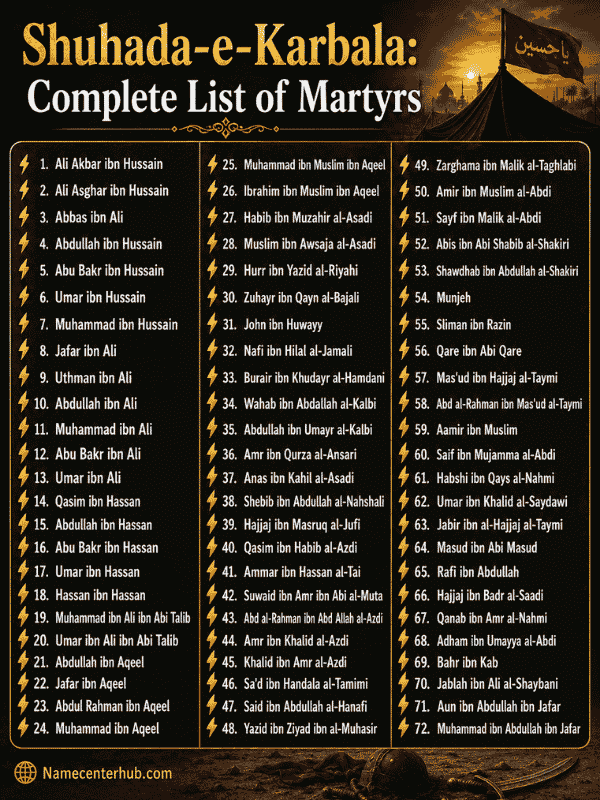
- Ali Akbar ibn Hussain
- Ali Asghar ibn Hussain
- Abbas ibn Ali
- Abdullah ibn Hussain
- Abu Bakr ibn Hussain
- Umar ibn Hussain
- Muhammad ibn Hussain
- Jafar ibn Ali
- Uthman ibn Ali
- Abdullah ibn Ali
- Muhammad ibn Ali
- Abu Bakr ibn Ali
- Umar ibn Ali
- Qasim ibn Hassan
- Abdullah ibn Hassan
- Abu Bakr ibn Hassan
- Umar ibn Hassan
- Hassan ibn Hassan
- Muhammad ibn Ali ibn Abi Talib
- Umar ibn Ali ibn Abi Talib
- Abdullah ibn Aqeel
- Jafar ibn Aqeel
- Abdul Rahman ibn Aqeel
- Muhammad ibn Aqeel
- Muhammad ibn Muslim ibn Aqeel
- Ibrahim ibn Muslim ibn Aqeel
- Habib ibn Muzahir al-Asadi
- Muslim ibn Awsaja al-Asadi
- Hurr ibn Yazid al-Riyahi
- Zuhayr ibn Qayn al-Bajali
- John ibn Huwayy
- Nafi ibn Hilal al-Jamali
- Burair ibn Khudayr al-Hamdani
- Wahab ibn Abdallah al-Kalbi
- Abdullah ibn Umayr al-Kalbi
- Amr ibn Qurza al-Ansari
- Anas ibn Kahil al-Asadi
- Shebib ibn Abdullah al-Nahshali
- Hajjaj ibn Masruq al-Jufi
- Qasim ibn Habib al-Azdi
- Ammar ibn Hassan al-Tai
- Suwaid ibn Amr ibn Abi al-Muta
- Abd al-Rahman ibn Abd Allah al-Azdi
- Amr ibn Khalid al-Azdi
- Khalid ibn Amr al-Azdi
- Sa’d ibn Handala al-Tamimi
- Said ibn Abdullah al-Hanafi
- Yazid ibn Ziyad ibn al-Muhasir
- Zarghama ibn Malik al-Taghlabi
- Amir ibn Muslim al-Abdi
- Sayf ibn Malik al-Abdi
- Abis ibn Abi Shabib al-Shakiri
- Shawdhab ibn Abdullah al-Shakiri
- Munjeh
- Sliman ibn Razin
- Qare ibn Abi Qare
- Mas’ud ibn Hajjaj al-Taymi
- Abd al-Rahman ibn Mas’ud al-Taymi
- Aamir ibn Muslim
- Saif ibn Mujamma al-Abdi
- Habshi ibn Qays al-Nahmi
- Umar ibn Khalid al-Saydawi
- Jabir ibn al-Hajjaj al-Taymi
- Masud ibn Abi Masud
- Rafi ibn Abdullah
- Hajjaj ibn Badr al-Saadi
- Qanab ibn Amr al-Nahmi
- Adham ibn Umayya al-Abdi
- Bahr ibn Kab
- Jablah ibn Ali al-Shaybani
- Aun ibn Abdullah ibn Jafar
- Muhammad ibn Abdullah ibn Jafar
Family Members of Imam Hussain (AS) in Karbala
- Ali Akbar ibn Hussain – Son of Imam Hussain, known for his resemblance to Prophet Muhammad (PBUH)
- Ali Asghar ibn Hussain – Infant son of Imam Hussain, killed by an arrow while in his father’s arms
- Abbas ibn Ali – Brother of Imam Hussain and the flag bearer of Karbala
- Abdullah ibn Hussain – Young son of Imam Hussain martyred on the battlefield
- Abu Bakr ibn Hussain – Son of Imam Hussain who fought bravely and was martyred
- Umar ibn Hussain – Son of Imam Hussain who gave his life in Karbala
- Muhammad ibn Hussain – Son of Imam Hussain martyred alongside his brothers
- Jafar ibn Ali – Brother of Imam Hussain martyred in the battle
- Uthman ibn Ali – Brother of Imam Hussain who was killed by an arrow
- Abdullah ibn Ali – Brother of Imam Hussain who fought and was martyred
- Muhammad ibn Ali – Brother of Imam Hussain martyred at Karbala
- Abu Bakr ibn Ali – Brother of Imam Hussain who gave his life on that day
- Umar ibn Ali – Brother of Imam Hussain martyred in the battle of Karbala
Martyrs of Karbala from the Family of Imam Hasan (AS)
- Muhammad ibn Ali – Son of Imam Ali martyred at Karbala
- Umar ibn Ali – Son of Imam Ali who was killed in the battle
- Abdullah ibn Aqeel – Grandson of Aqeel ibn Abi Talib martyred in Karbala
- Jafar ibn Aqeel – Son of Aqeel ibn Abi Talib who was martyred
- Abdul Rahman ibn Aqeel – Son of Aqeel ibn Abi Talib martyred on that day
- Muhammad ibn Aqeel – Son of Aqeel ibn Abi Talib who gave his life at Karbala
- Muhammad ibn Muslim ibn Aqeel – Grandson of Muslim ibn Aqeel martyred in the battle
- Ibrahim ibn Muslim ibn Aqeel – Grandson of Muslim ibn Aqeel martyred at Karbala
Martyrs from Banu Hashim in Karbala
- Ali Akbar ibn Hussain – He was the eldest son of Imam Hussain. He looked exactly like Prophet Muhammad (PBUH) and was martyred at a young age on the day of Ashura.
- Ali Asghar ibn Hussain – He was the infant son of Imam Hussain, only six months old. He was killed by a three-pronged arrow while Imam Hussain held him in his arms asking for water.
- Abbas ibn Ali – He was the brother of Imam Hussain and the flag bearer of the camp. He went to fetch water for the children and was martyred at the riverbank with both arms cut off.
- Abdullah ibn Hussain – He was a young son of Imam Hussain. He came to the battlefield to defend his father and was martyred while still very young.
- Abu Bakr ibn Hussain – He was a son of Imam Hussain who fought bravely on the day of Karbala. He gave his life standing beside his father on the plains of Karbala.
- Umar ibn Hussain – He was a son of Imam Hussain who stepped onto the battlefield with full courage. He was martyred while defending his father and the camp.
- Muhammad ibn Hussain –
He was a son of Imam Hussain who stood firm with his family. He fought and was martyred on the day of Ashura in Karbala. - Jafar ibn Ali –
He was a brother of Imam Hussain from the family of Banu Hashim. He fought courageously and was martyred in the battle of Karbala. - Uthman ibn Ali –
He was a brother of Imam Hussain who was killed by an arrow on the battlefield. He died defending the truth alongside his brother. - Abdullah ibn Ali –
He was a brother of Imam Hussain who fought with great bravery. He was martyred on the plains of Karbala while standing for justice. - Muhammad ibn Ali –
He was a brother of Imam Hussain from the Banu Hashim family. He gave his life on the day of Ashura fighting alongside Imam Hussain. - Abu Bakr ibn Ali – He was a brother of Imam Hussain who stood firm until his last breath. He was martyred at Karbala while defending his brother and Islam.
- Umar ibn Ali – He was a brother of Imam Hussain who fought in the battle of Karbala. He was martyred bravely while standing with the family of the Prophet (PBUH).
- Qasim ibn Hassan – He was the young son of Imam Hassan and nephew of Imam Hussain. He was married on the morning of Ashura and was martyred on the same day in battle.
- Abdullah ibn Hassan – He was a son of Imam Hassan who was very young at the time of Karbala. He ran onto the battlefield to protect Imam Hussain and was killed by a sword.
- Abu Bakr ibn Hassan – He was a son of Imam Hassan who came to Karbala with his uncle. He fought with great courage and was martyred on the day of Ashura.
- Umar ibn Hassan – He was a son of Imam Hassan who stood beside his uncle Imam Hussain. He gave his life on the plains of Karbala fighting for truth.
- Hassan ibn Hassan – He was a son of Imam Hassan who joined the battle of Karbala. He was martyred while defending Imam Hussain and the camp of the Prophet’s family.
- Muhammad ibn Ali ibn Abi Talib – He was a son of Imam Ali and a brother of Imam Hussain. He fought bravely at Karbala and was martyred on the day of Ashura.
- Umar ibn Ali ibn Abi Talib – He was a son of Imam Ali who stood firmly with Imam Hussain. He gave his life in the battle of Karbala defending his brother.
- Abdullah ibn Aqeel – He was a grandson of Aqeel ibn Abi Talib from the Banu Hashim family. He came to Karbala and was martyred while fighting alongside Imam Hussain.
- Jafar ibn Aqeel – He was a son of Aqeel ibn Abi Talib who joined Imam Hussain at Karbala. He fought with bravery and gave his life on the day of Ashura.
- Abdul Rahman ibn Aqeel – He was a son of Aqeel ibn Abi Talib who stood beside Imam Hussain. He was martyred in the battle while defending the family of the Prophet (PBUH).
- Muhammad ibn Aqeel – He was a son of Aqeel ibn Abi Talib who came to Karbala with great loyalty. He fought and was martyred on the plains of Karbala on Ashura.
- Muhammad ibn Muslim ibn Aqeel – He was a grandson of Muslim ibn Aqeel who traveled to Karbala. He was martyred while standing firmly with Imam Hussain in the battle.
- Aun ibn Abdullah ibn Jafar – He was a son of Abdullah ibn Jafar al-Tayyar and a nephew of Imam Hussain. He fought with great valor at Karbala and was martyred on the day of Ashura.
- Muhammad ibn Abdullah ibn Jafar – He was a son of Abdullah ibn Jafar al-Tayyar who came to Karbala with his brother Aun. He was martyred alongside his brother while defending Imam Hussain.
The Brave Sons of Hazrat Zainab (SA) in Karbala
Aun ibn Abdullah ibn Jafar – He was the son of Hazrat Zainab (SA) who fought bravely at Karbala and was martyred on the day of Ashura defending Imam Hussain.
Muhammad ibn Abdullah ibn Jafar – He was the second son of Hazrat Zainab (SA) who stood beside his brother Aun and was martyred on the plains of Karbala on the same day.
The Last Moments of Imam Hussain (AS)
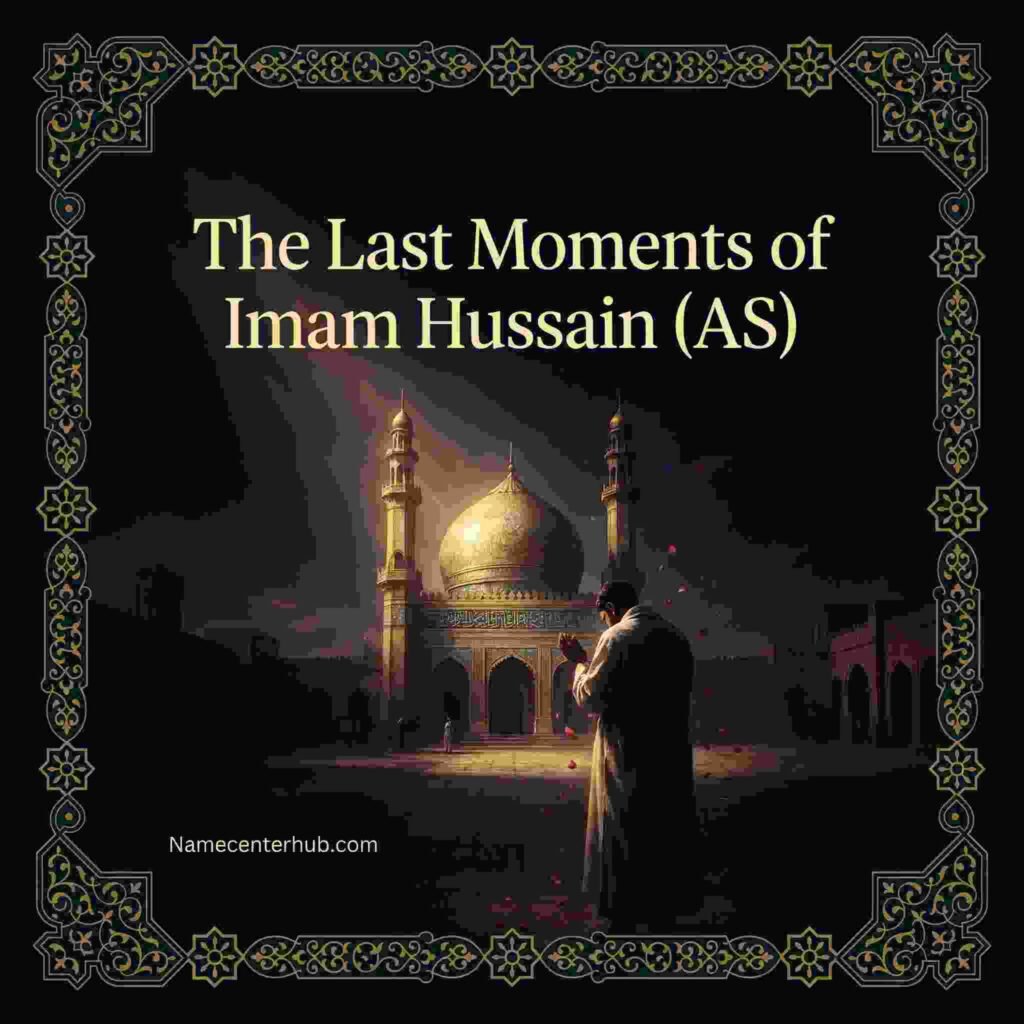
The last moments of Imam Hussain (AS) on the day of Ashura are the most painful pages in Islamic history. After all his companions and family members were martyred he stood alone on the plains of Karbala. He faced thousands of enemy soldiers with patience, dignity, and unshakable faith in Allah.
Imam Hussain (AS) gave a final sermon and asked the enemy one last time if they would stop this cruelty. No one listened and the arrows and swords came from every direction. He was wounded all over his body but he never fell on his knees and never begged for his life.
He finally fell from his horse after receiving countless wounds on his body. Shimr ibn Dhil Jawshan came forward and separated his blessed head from his body. The sky of Karbala turned red that day and the earth wept for the grandson of Prophet Muhammad (PBUH).
Biography of Hazrat Ali Akbar (AS)
Hazrat Ali Akbar (AS) was the eldest son of Imam Hussain (AS) and Umm Layla. He was born on the 11th of Shaban and was around 18 to 25 years old at the time of Karbala. He is remembered as one of the most beloved martyrs in Islamic history.
He looked exactly like Prophet Muhammad (PBUH) in his face, his voice, and his walk. Imam Hussain (AS) would often look at him to remember his grandfather the Holy Prophet. He was a young man of great beauty, courage, and strong faith who gave his life on the day of Ashura.
Hazrat Ali Asghar (AS): The Youngest Martyr of Karbala
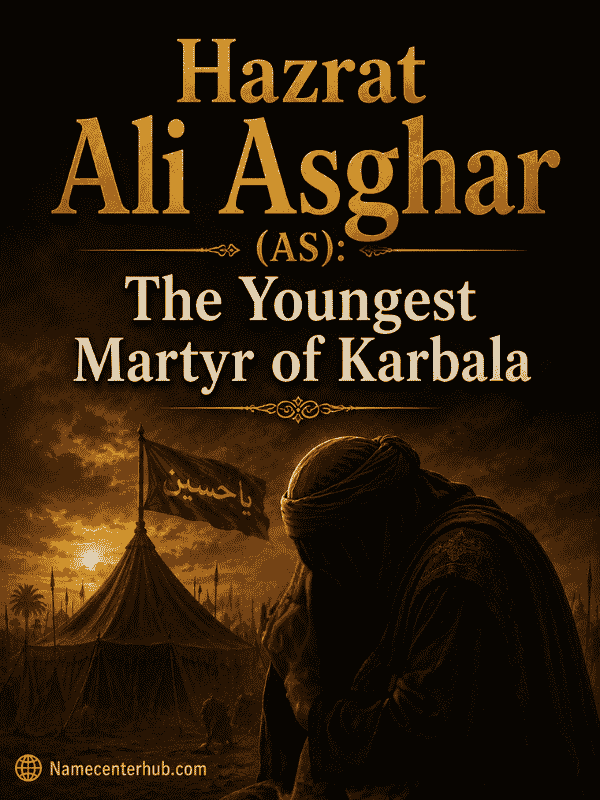
Hazrat Ali Asghar (AS) was the youngest son of Imam Hussain (AS) and his wife Rubab. He was only six months old at the time of the battle of Karbala. He is known as the youngest martyr in Islamic history and his story fills every heart with deep pain.
On the day of Ashura, the children in the camp had no water for many hours. Imam Hussain (AS) brought his infant son Ali Asghar to the battlefield to ask for water. A cruel arrow struck the baby’s throat and he was martyred in his father’s arms.
Hazrat Abbas Alamdar (AS) and His Sacrifice
His Identity and Family
Hazrat Abbas (AS) was the son of Imam Ali (AS) and Fatima binte Hizam, also known as Ummul Baneen. He was the half brother of Imam Hussain (AS) and was raised with deep love and respect in the house of Imam Ali. He was known for his tall and powerful built and his handsome appearance.
His Title Alamdar
Hazrat Abbas (AS) was given the title Alamdar which means the flag bearer. He carried the flag of Imam Hussain’s camp throughout the battle of Karbala. This title became his most famous name and is remembered with great honor till this day.
His Loyalty to Imam Hussain (AS)
Hazrat Abbas (AS) had unmatched loyalty toward his brother Imam Hussain (AS). He never left his side even when the situation became very difficult and dangerous. He considered it his greatest honor to serve and protect his brother until his last breath.
His Role on the Day of Ashura
On the day of Ashura Hazrat Abbas (AS) played a central role in the defense of the camp. He stood firm against thousands of enemy soldiers with great courage and strength. He was the commander and protector of the small group standing with Imam Hussain (AS).
His Mission to Fetch Water
When the children and women in the camp were crying from thirst Hazrat Abbas (AS) went to the river Euphrates. He filled a mashkiza which is a water skin to bring water back to the thirsty children. He did not drink a single drop of water himself out of respect for the thirst of Imam Hussain and the children.
His Martyrdom at the River
On his way back from the river the enemies attacked Hazrat Abbas (AS) from all sides. First his right arm was cut off then his left arm was cut off by the enemy swords. He held the water skin with his teeth but an arrow struck it and the water spilled and he was then struck on the head and martyred on the banks of the Euphrates.
His Legacy and Honor in Islam
Hazrat Abbas (AS) is remembered as a symbol of loyalty, bravery, and sacrifice in Islamic history. His shrine in Karbala Iraq stands near the shrine of Imam Hussain and is visited by millions every year. He is called the Gate of Needs by many Muslims who believe his intercession is a source of great blessing.
Muslim ibn Aqeel: The First Martyr of the Karbala Movement
His Identity and Relation to Imam Hussain
Muslim ibn Aqeel was the cousin and trusted representative of Imam Hussain (AS). He was the son of Aqeel ibn Abi Talib, who was the brother of Imam Ali (AS). He was known for his bravery, loyalty, and strong faith.
His Mission to Kufa
Imam Hussain (AS) sent Muslim ibn Aqeel to Kufa to check the sincerity of the people there. The people of Kufa had written thousands of letters inviting Imam Hussain to come and lead them. Muslim arrived in Kufa and was welcomed by a very large number of people.
The Betrayal of the People of Kufa
When the governor Ubaidullah ibn Ziyad came to power in Kufa, the people quickly turned away from Muslim. Those who had promised support left him alone one by one out of fear. Muslim was left with no helpers and was forced to hide in the city.
His Arrest and Capture
Muslim ibn Aqeel was given shelter by a woman named Taw’a in Kufa. He was soon discovered and surrounded by the soldiers of Ibn Ziyad. He fought bravely alone until he was overpowered and captured.
His Martyrdom
Muslim ibn Aqeel was brought before Ubaidullah ibn Ziyad and refused to beg for his life. He was taken to the top of the palace and beheaded on the 9th of Dhul Hijjah, 60 AH. His body was thrown from the roof of the palace in Kufa.
His Legacy in the Karbala Movement
Muslim ibn Aqeel is honored as the first martyr of the Karbala movement. His sacrifice showed the world the betrayal and cruelty of the people of Kufa. His mission and death were a painful sign of what was coming for Imam Hussain (AS) on the day of Ashura.
Lessons from the Sacrifices of Shuhada-e-Karbala
Always Stand for Truth
The martyrs of Karbala teach us to always speak and stand for truth even when it is very difficult and dangerous.
Never Bow Before Injustice
Imam Hussain (AS) teaches us that a true believer never accepts oppression or bows before a corrupt and unjust ruler.
Loyalty and Brotherhood
The companions of Karbala stayed with Imam Hussain until their last breath and teach us the true meaning of loyalty.
Sacrifice for a Greater Cause
The martyrs gave up everything they had for Islam and teach us that some causes are worth every sacrifice.
Patience in the Face of Hardship
Imam Hussain (AS) and his family faced hunger and thirst with full patience and teach us to never lose hope in Allah.
Courage in the Face of Fear
The 72 martyrs faced thousands of enemy soldiers without fear and teach us to always do what is right no matter what.
The Power of Faith
The strong faith of the martyrs gave them the strength to face death with peace and teaches us that faith in Allah is our greatest power.
Dignity and Honor Above Everything
Imam Hussain (AS) chose death over humiliation and teaches us to always protect our dignity and self respect in life.
The Role of Women in Difficult Times
Hazrat Zainab (AS) spoke fearlessly for truth after Karbala and teaches us that women have a powerful role in standing for justice.
The Message of Karbala Lives Forever
The sacrifice of Karbala teaches every generation that the voice of truth and justice can never be silenced by any power in the world.
Frequently Asked Questions
Who were the 72 martyrs of Karbala?
The 72 martyrs of Karbala were the companions and family members of Imam Hussain (AS) who gave their lives on the day of Ashura. They stood against the army of Yazid to protect the truth and justice of Islam.
When did the battle of Karbala take place?
The battle of Karbala took place on the 10th of Muharram 61 AH which is known as the day of Ashura. This day is remembered every year by millions of Muslims around the world.
Who was the leader of the martyrs of Karbala?
Imam Hussain (AS) the grandson of Prophet Muhammad (PBUH) was the leader of the martyrs of Karbala. He refused to give his pledge to Yazid and stood firm for truth until his last breath.
Who was the youngest martyr of Karbala?
Hazrat Ali Asghar (AS) was the youngest martyr of Karbala who was only six months old. He was killed by an arrow while Imam Hussain (AS) held him in his arms asking for water for the child.
Who was the flag bearer of Karbala?
Hazrat Abbas ibn Ali (AS) was the flag bearer of Karbala and is known by the title Alamdar. He was the brother of Imam Hussain (AS) and was martyred at the banks of the river Euphrates.
How many people were in the army of Yazid at Karbala?
The army of Yazid had around 30,000 soldiers facing the small group of 72 companions and family members of Imam Hussain. This shows how greatly outnumbered Imam Hussain and his companions were on that day.
Why did Imam Hussain refuse to give allegiance to Yazid?
Imam Hussain (AS) refused to give allegiance to Yazid because Yazid was a corrupt and unjust ruler who did not follow the teachings of Islam. Imam Hussain believed that staying silent would destroy the true values of Islam forever.
Who was Hurr ibn Yazid al-Riyahi in Karbala?
Hurr ibn Yazid al-Riyahi was a commander of Yazid’s army who later changed sides and joined Imam Hussain (AS). He repented before the battle and was martyred fighting alongside Imam Hussain on the day of Ashura.
Where is the battle of Karbala located?
The battle of Karbala took place in the city of Karbala which is located in present day Iraq. Today the shrines of Imam Hussain (AS) and Hazrat Abbas (AS) stand in that city and are visited by millions every year.
What is the importance of the martyrs of Karbala in Islam?
The martyrs of Karbala are remembered as symbols of truth, sacrifice, and standing against oppression in Islam. Their story teaches every generation to never bow before injustice and always stand firm for the right path.
Conclusion
The 72 martyrs of Karbala gave their lives for truth, justice, and the values of Islam. They stood beside Imam Hussain (AS) knowing they would not return home alive. Their sacrifice is one of the greatest examples of courage and faith in all of human history.
The story of Karbala will never be forgotten as long as the world exists. Every year millions of Muslims remember these 72 brave souls with tears and deep respect. Their names, their sacrifices, and their love for Allah live forever in the hearts of believers around the world.