

When we think of deadly animals, our minds often jump to sharks, lions or venomous snakes but nature has a way of surprising us.Some of the world’s most dangerous animals are ones we’d barely glance at twice: a tiny mosquito humming past our ear, a slow-moving snail hiding in shallow water or a colorful frog no bigger than a thumbnail. Deadliness, it turns out, doesn’t always come with claws and fangs.
This ranked list brings together 115+ of the world’s deadliest animals, measured not just by venom or brute force, but by the real human lives they claim each year. From the depths of the ocean to your own backyard, these creatures remind us that the animal kingdom operates on its own brutal set of rules and that respect for wildlife isn’t optional. It’s survival.
What Makes an Animal Dangerous?

What makes an animal dangerous isn’t always size or aggression. Venom, speed, disease, and sheer proximity to humans all play a role. A mosquito kills far more people each year than any shark or lion — not through force, but through the diseases it silently carries. Some animals kill out of fear, others out of instinct, and some simply because their biology is devastatingly lethal. In the end, danger comes in many shapes, sizes, and species
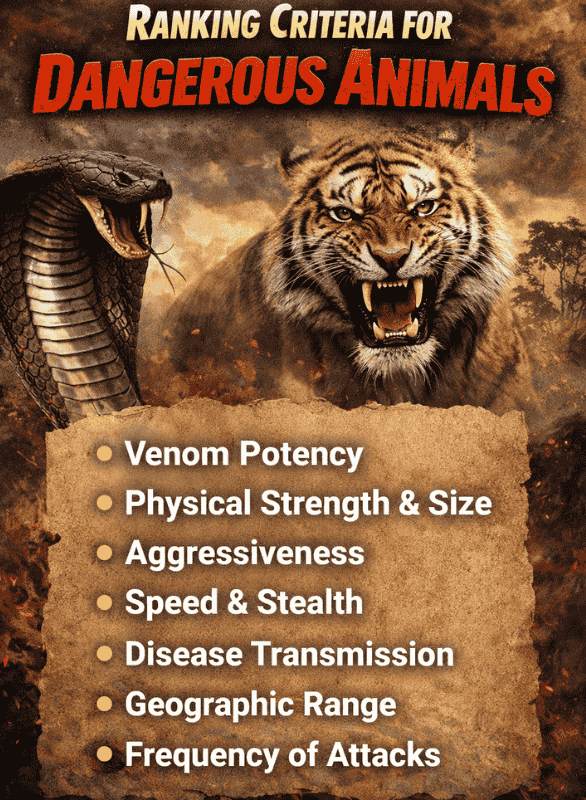
Ranking Criteria for Dangerous Animals
Annual Human Deaths
The number of human fatalities caused directly or indirectly each year
Venom Potency
The toxicity level of the animal’s venom or poison and how quickly it acts
Physical Strength & Size
Bite force, body mass, and raw power that can cause fatal injuries
Aggressiveness
Whether the animal attacks unprovoked or is highly territorial by nature
Speed & Stealth
How quickly or silently an animal can strike before a human can react
Disease Transmission
The ability to carry and spread deadly viruses, parasites, or bacteria
Geographic Range
How widely distributed the animal is and how often it encounters humans
Frequency of Attacks
The regularity of reported attacks or encounters that result in harm
Other Lethal Creatures You Should Know
The deadliest animals aren’t always the ones making headlines. Beyond the well-known killers, there’s a long list of creatures that quietly rack up casualties every year — ones that rarely get the spotlight they deserve. From obscure jellyfish species to venomous insects lurking in your garden, these animals are just as worthy of caution:
- Slow Loris – Its bite delivers venom that can cause anaphylactic shock
- Swan – Highly territorial and capable of drowning a full-grown adult
- Cone Snail – Its tiny harpoon like tooth injects venom with no known antidote
- Cassowary – Often called the world’s most dangerous bird, with razor-sharp claws
- Giant Centipede – Delivers an intensely painful, medically significant venom
Why Cute-Looking Animals Can Also Kill You
Nature has a cruel sense of humor. Some of the most adorable, harmless-looking creatures on the planet are quietly among the most dangerous. A fluffy slow loris with wide eyes, a plump little pufferfish, or a brightly colored dart frog — none of them look like threats. But looks are wildly deceiving in the animal kingdom. Here’s why you should never judge danger by appearances:
- Bright colors in nature often signal toxicity, not beauty
- Small animals frequently carry venom far more potent than large predators
- Seemingly gentle animals like deer and cows cause thousands of deaths annually through collisions and trampling
- Domesticated or familiar animals often lower our guard, making encounters more dangerous
Where Are the Most Dangerous Animals Found?
Dangerous animals don’t stick to remote jungles or deep oceans they’re far more widespread than most people realize. That said, certain parts of the world are undeniably more hazardous than others. Whether it’s the snake-dense grasslands of South Asia or the shark-patrolled coastlines of Australia, geography plays a huge role in your odds of a deadly encounter. Some hotspots to be aware of:
Sub-Saharan Africa
Home to hippos, lions, crocodiles, and the tsetse fly
Australia
Notorious for venomous snakes, spiders, jellyfish, and saltwater crocodiles
South Asia
Accounts for the highest number of snakebite deaths globally
Amazon Rainforest
Dense with poison dart frogs, piranhas, and bullet ants
Southeast Asia
High risk from mosquito-borne diseases and venomous marine life
What animal kills the most humans in the world
The answer might genuinely surprise you it’s not a lion, a crocodile, or even a shark. The single deadliest animal on Earth is the mosquito. This tiny, fragile insect is responsible for over one million human deaths every year, primarily through the transmission of malaria, dengue fever, yellow fever, and the Zika virus. It doesn’t bite out of aggression or hunt for food it simply feeds, and in doing so, spreads disease on a scale no predator could ever match. Behind the mosquito, humans themselves rank second, followed by snakes, dogs, and freshwater snails a list that consistently catches people off guard
Top 30 Most Dangerous Animals in the World
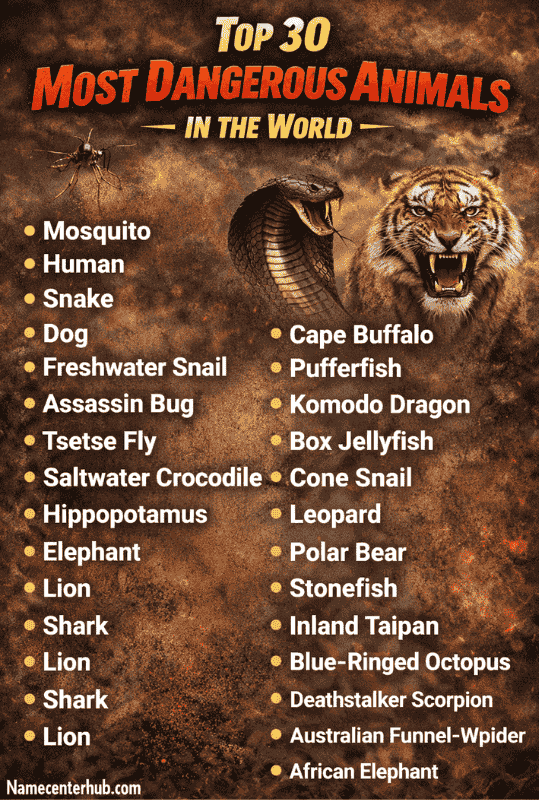
- Mosquito
- Human
- Snake
- Dog
- Freshwater Snail
- Assassin Bug
- Tsetse Fly
- Saltwater Crocodile
- Hippopotamus
- Elephant
- Lion
- Shark
- Cape Buffalo
- Pufferfish
- Komodo Dragon
- Box Jellyfish
- Cone Snail
- Leopard
- Polar Bear
- Stonefish
- Inland Taipan
- Blue-Ringed Octopus
- Deathstalker Scorpion
- Australian Funnel-Web Spider
- African Elephant
- Nile Crocodile
- Tiger
- Hyena
- Wolves
- Cassowary
Full List of the Top 1200 Most Dangerous Animals
- Mosquito
- Human
- Snake
- Dog
- Freshwater Snail
- Assassin Bug
- Tsetse Fly
- Saltwater Crocodile
- Hippopotamus
- Elephant
- Lion
- Shark
- Cape Buffalo
- Pufferfish
- Komodo Dragon
- Box Jellyfish
- Cone Snail
- Leopard
- Polar Bear
- Stonefish
- Inland Taipan
- Blue-Ringed Octopus
- Deathstalker Scorpion
- Australian Funnel-Web Spider
- Nile Crocodile
- Tiger
- Hyena
- Wolf
- Cassowary
- Slow Loris
- Giant Centipede
- Africanized Honey Bee
- Fire Ant
- Black Widow Spider
- Brown Recluse Spider
- King Cobra
- Black Mamba
- Boomslang
- Russell’s Viper
- Saw-Scaled Viper
- Eastern Brown Snake
- Taipan
- Tiger Snake
- Death Adder
- Banded Krait
- Stingray
- Lionfish
- Moray Eel
- Barracuda
- Piranha
- Electric Eel
- Giant Pacific Octopus
- Portuguese Man O’ War
- Irukandji Jellyfish
- Textile Cone Snail
- Sea Snake
- Flower Urchin
- Bobbit Worm
- Horned Shark
- Bull Shark
- Great White Shark
- Tiger Shark
- Oceanic Whitetip Shark
- Hammerhead Shark
- Grizzly Bear
- Black Bear
- Sun Bear
- Jaguar
- Cheetah
- Cougar
- Snow Leopard
- Wild Boar
- African Wild Dog
- Dingo
- Wolverine
- Honey Badger
- Moose
- Bison
- Water Buffalo
- Rhinoceros
- Gorilla
- Chimpanzee
- Baboon
- Mandrill
- Porcupine
- Platypus
- Gila Monster
- Mexican Beaded Lizard
- Snapping Turtle
- Alligator Snapping Turtle
- American Alligator
- Gharial
- Monitor Lizard
- Geese
- Swan
- Ostrich
- Emu
- Secretary Bird
- Harpy Eagle
- Great Horned Owl
- Herring Gull
- Titan Beetle
- Bullet Ant
- Tarantula Hawk Wasp
- Japanese Giant Hornet
- Botfly
- Sand Fly
- Deer Fly
- Kissing Bug
- Rat Flea
- Deer Tick
- Lone Star Tick
- Human Louse
- Scabies Mite
- Candiru Fish
- Goliath Tigerfish
- Wels Catfish
- Arapaima
- Alligator Gar
- Electric Ray
- Giant Moray Eel
- Spotted Eagle Ray
- Blue-Spotted Ribbontail Ray
- Shortfin Mako Shark
- Nurse Shark
- Wobbegong Shark
- Caribbean Reef Shark
- Lemon Shark
- Blacktip Reef Shark
- Whitetip Reef Shark
- Sand Tiger Shark
- Zebra Shark
- Greenland Shark
- Six-Gill Shark
- Pacific Sleeper Shark
- Frilled Shark
- Angel Shark
- Carpet Shark
- Sawfish
- Giant Freshwater Stingray
- Common Stingray
- Round Stingray
- Bat Ray
- Manta Ray
- Devil Ray
- Giant Squid
- Humboldt Squid
- Firefly Squid
- Vampire Squid
- Colossal Squid
- Mantis Shrimp
- Pistol Shrimp
- Coconut Crab
- Japanese Spider Crab
- Stone Crab
- Horseshoe Crab
- Sea Urchin
- Crown of Thorns Starfish
- Textile Cone Snail
- Geography Cone Snail
- Tulip Cone Snail
- Striated Cone Snail
- Marbled Cone Snail
- Sea Wasp Jellyfish
- Lion’s Mane Jellyfish
- Moon Jellyfish
- Nomura’s Jellyfish
- Mauve Stinger Jellyfish
- Cannonball Jellyfish
- Mushroom Cap Jellyfish
- Upside-Down Jellyfish
- Sea Nettle
- Purple Jellyfish
- Fire Coral
- Feather Crown Jellyfish
- Stalked Jellyfish
- Narcomedusae Jellyfish
- Cauliflower Jellyfish
- Immortal Jellyfish
- Crystal Jellyfish
- Spotted Jellyfish
- Fried Egg Jellyfish
- Siphonophore
- Blue Button Jellyfish
- By-the-Wind Sailor
- Velella Jellyfish
- Marrus Orthocanna
- Apolemia Jellyfish
- Physonect Siphonophore
- Praya Dubia
- Hippopodius Hippopus
- Rosacea Cymbantha
- Bargmannia Elongata
- Forskalia Edwardsi
- Agalma Elegans
- Nanomia Bijuga
- Stephalia Dilata
- Athorybia Rosacea
- Erenna Richardi
- Frillagalma Vityazi
- Tottonophyes Enigmatica
- Chuniphyes Moserae
- Diphyes Dispar
- Sulculeolaria Chuni
- Muggiaea Atlantica
- Lensia Conoidea
- Dimophyes Arctica
- Bassia Bassensis
- Abylopsis Tetragona
- Ceratocymba Leuckartii
- Nectadamas Diomedeae
- Enneagonum Hyalinum
- Clausophyes Ovata
- Crystallophyes Amygdalina
- Vogtia Pentacantha
- Vogtia Spinosa
- Vogtia Glabra
- Hippopodius Luteus
- Hippopodius Citreus
- Diphyes Bojani
- Common Krait
- Indian Krait
- Malayan Krait
- Many-Banded Krait
- Red-Headed Krait
- Yellow-Lipped Sea Krait
- Olive Sea Snake
- Beaked Sea Snake
- Annulated Sea Snake
- Elegant Sea Snake
- Spine-Bellied Sea Snake
- Horned Sea Snake
- Stokes’ Sea Snake
- Dusky Sea Snake
- Hardwicke’s Sea Snake
- Peron’s Sea Snake
- Shaw’s Sea Snake
- Viperine Sea Snake
- Black-Headed Sea Snake
- Turtle-Headed Sea Snake
- Slender Sea Snake
- Spotted Sea Snake
- Small-Headed Sea Snake
- Flat-Tailed Sea Snake
- Jerdon’s Sea Snake
- Common Sea Snake
- Indian Cobra
- Monocled Cobra
- Spitting Cobra
- Forest Cobra
- Cape Cobra
- Egyptian Cobra
- Mozambique Spitting Cobra
- Red Spitting Cobra
- Nubian Spitting Cobra
- Samar Cobra
- Philippine Cobra
- Equatorial Spitting Cobra
- Javan Spitting Cobra
- Sumatran Spitting Cobra
- Indochinese Spitting Cobra
- Caspian Cobra
- Snouted Cobra
- Anchieta’s Cobra
- Banded Water Cobra
- Congo Water Cobra
- Gold’s Tree Cobra
- Christy’s Tree Cobra
- Black Tree Cobra
- Western Green Mamba
- Eastern Green Mamba
- Jameson’s Mamba
- Puff Adder
- Gaboon Viper
- Rhinoceros Viper
- Night Adder
- Berg Adder
- Horned Adder
- Peringuey’s Adder
- Many-Horned Adder
- Desert Mountain Adder
- Plain Mountain Adder
- Lowland Swamp Viper
- Usambara Mountain Bush Viper
- Mt. Kenya Bush Viper
- Rough-Scaled Bush Viper
- Hairy Bush Viper
- Great Lakes Bush Viper
- Sedge Viper
- Ethiopian Mountain Viper
- Bale Mountain Viper
- Uzungwe Viper
- Ashe’s Bushviper
- Hindenburg Ground Viper
- Matilda’s Horned Viper
- Tai Pale-Headed Forest Viper
- Western Bush Viper
- Variable Bush Viper
- Velvety Green Night Adder
- Snouted Night Adder
- Rhombic Night Adder
- Forest Night Adder
- Dwarf Night Adder
- Bibron’s Stiletto Snake
- Cape Stiletto Snake
- Eastern Stiletto Snake
- Natal Purple-Glossed Snake
- Natal Black Snake
- Common Purple-Glossed Snake
- Eastern Tiger Snake
- Chappell Island Tiger Snake
- King Island Tiger Snake
- Krefft’s Tiger Snake
- Peninsula Tiger Snake
- Rough-Scaled Snake
- Papuan Taipan
- Central Ranges Taipan
- Coastal Taipan
- Western Desert Taipan
- Fierce Snake
- Mulga Snake
- Spotted Mulga Snake
- Pilbara Cobra
- Collett’s Snake
- Blue-Bellied Black Snake
- Red-Bellied Black Snake
- Spotted Black Snake
- Butler’s Snake
- Weigel’s Snake
- Oenpelli Python
- Scrub Python
- Amethystine Python
- Olive Python
- Water Python
- Children’s Python
- Spotted Python
- Stimson’s Python
- Pygmy Python
- Woma Python
- Black-Headed Python
- Carpet Python
- Diamond Python
- Jungle Carpet Python
- Coastal Carpet Python
- Centralian Carpet Python
- Southwest Carpet Python
- Bredl’s Python
- Boelen’s Python
- Green Tree Python
- White-Lipped Python
- Brown Tree Snake
- Common Tree Snake
- Yellow-Faced Whip Snake
- Eastern Small-Eyed Snake
- Little Whip Snake
- Bandy-Bandy Snake
- Golden Tree Snake
- Twin-Barred Tree Snake
- Paradise Tree Snake
- Ornate Flying Snake
- Banded Flying Snake
- Moluccan Flying Snake
- Sri Lankan Flying Snake
- Chrysopelea Taprobanica
- Black-Spitting Thicktail Scorpion
- Yellow Fat-Tailed Scorpion
- Tunisian Fat-Tailed Scorpion
- Arabian Fat-Tailed Scorpion
- Saharan Fat-Tailed Scorpion
- Israeli Gold Scorpion
- Leiurus Quinquestriatus
- Palestine Yellow Scorpion
- Iranian Yellow Scorpion
- Hemiscorpius Lepturus
- Hottentotta Tamulus
- Hottentotta Jayakari
- Hottentotta Franzwerneri
- Buthus Occitanus
- Buthus Atlantis
- Androctonus Australis
- Androctonus Bicolor
- Androctonus Amoreuxi
- Androctonus Crassicauda
- Centruroides Sculpturatus
- Centruroides Vittatus
- Centruroides Exilicauda
- Centruroides Limpidus
- Centruroides Elegans
- Centruroides Noxius
- Centruroides Suffusus
- Tityus Serrulatus
- Tityus Bahiensis
- Tityus Stigmurus
- Tityus Obscurus
- Tityus Cambridgei
- Tityus Metuendus
- Tityus Silvestris
- Tityus Trivittatus
- Rhopalurus Junceus
- Opisthacanthus Elatus
- Hadrurus Arizonensis
- Hadrurus Spadix
- Hadrurus Obscurus
- Vaejovis Spinigerus
- Parabuthus Transvaalicus
- Parabuthus Granulatus
- Parabuthus Villosus
- Parabuthus Capensis
- Parabuthus Liosoma
- Parabuthus Leiosoma
- Babycurus Jacksoni
- Uroplectes Triangulifer
- Uroplectes Carinatus
- Lychas Mucronatus
- Isometrus Maculatus
- Chaerilus Celebensis
- Liocheles Australasiae
- Hormurus Waigiensis
- Hadogenes Troglodytes
- Heterometrus Spinifer
- Heterometrus Swammerdami
- Heterometrus Laoticus
- Pandinus Imperator
- Pandinus Cavimanus
- Brazilian Wandering Spider
- Chilean Recluse Spider
- Six-Eyed Sand Spider
- Redback Spider
- Sydney Funnel-Web Spider
- Northern Tree Funnel-Web Spider
- Southern Tree Funnel-Web Spider
- Port Macquarie Funnel-Web Spider
- Toowoomba Funnel-Web Spider
- Blue Mountains Funnel-Web Spider
- Mouse Spider
- Trapdoor Spider
- Wolf Spider
- Hobo Spider
- Yellow Sac Spider
- Violin Spider
- Long-Legged Sac Spider
- Giant House Spider
- Domestic House Spider
- Common Garden Spider
- Orb Weaver Spider
- Golden Silk Spider
- Goliath Birdeater Spider
- King Baboon Spider
- Usambara Orange Baboon Spider
- Cobalt Blue Tarantula
- Greenbottle Blue Tarantula
- Salmon Pink Birdeater
- Brazilian Black Tarantula
- Mexican Redknee Tarantula
- Curly Hair Tarantula
- Arizona Blonde Tarantula
- Desert Blonde Tarantula
- Stripe Knee Tarantula
- Colombian Giant Tarantula
- Chaco Golden Knee Tarantula
- Brazilian Red and White Tarantula
- Antilles Pinktoe Tarantula
- Martinique Pinktoe Tarantula
- Purple Pinktoe Tarantula
- Common Pinktoe Tarantula
- Venezuelan Suntiger Tarantula
- Pampas Tawny Red Tarantula
- Brazilian Giant Blonde Tarantula
- Brazilian Giant White Knee Tarantula
- White-Collared Monkey
- Mandrill
- Gelada Baboon
- Hamadryas Baboon
- Olive Baboon
- Yellow Baboon
- Guinea Baboon
- Chacma Baboon
- Vervet Monkey
- Patas Monkey
- Rhesus Macaque
- Crab-Eating Macaque
- Pig-Tailed Macaque
- Japanese Macaque
- Barbary Macaque
- Toque Macaque
- Lion-Tailed Macaque
- Celebes Crested Macaque
- Tibetan Macaque
- Stump-Tailed Macaque
- Assam Macaque
- Bonnet Macaque
- Formosan Rock Macaque
- Taiwan Macaque
- Mindanao Bleeding-Heart Monkey
- Bonobo
- Sumatran Orangutan
- Bornean Orangutan
- Tapanuli Orangutan
- Silvery Gibbon
- Lar Gibbon
- Agile Gibbon
- Bornean White-Bearded Gibbon
- Mueller’s Bornean Gibbon
- Abbott’s Gray Gibbon
- Northern Gray Gibbon
- Southern Gray Gibbon
- Kloss’s Gibbon
- Hoolock Gibbon
- Western Hoolock Gibbon
- Eastern Hoolock Gibbon
- Skywalker Hoolock Gibbon
- Siamang
- Crested Gibbon
- Eastern Black Crested Gibbon
- Western Black Crested Gibbon
- Northern White-Cheeked Gibbon
- Southern White-Cheeked Gibbon
- Yellow-Cheeked Gibbon
- Red-Cheeked Gibbon
- Pileated Gibbon
- Cape Lion
- Barbary Lion
- Asiatic Lion
- Bengal Tiger
- Amur Tiger
- Sumatran Tiger
- Malayan Tiger
- Indochinese Tiger
- South China Tiger
- Amur Leopard
- Arabian Leopard
- Persian Leopard
- Sri Lankan Leopard
- Indian Leopard
- Javan Leopard
- African Leopard
- Clouded Leopard
- Sunda Clouded Leopard
- Marbled Cat
- Bay Cat
- Asian Golden Cat
- African Golden Cat
- Serval
- Caracal
- Ocelot
- Margay
- Oncilla
- Geoffroy’s Cat
- Kodkod
- Andean Mountain Cat
- Pampas Cat
- Jaguarundi
- Bobcat
- Canada Lynx
- Iberian Lynx
- Eurasian Lynx
- Fishing Cat
- Leopard Cat
- Rusty-Spotted Cat
- Flat-Headed Cat
- Sand Cat
- Black-Footed Cat
- Jungle Cat
- Pallas’s Cat
- Chinese Mountain Cat
- Wildcat
- African Wildcat
- European Wildcat
- Asiatic Wildcat
- Cape Fox
- Arctic Fox
- Red Fox
- Swift Fox
- Kit Fox
- Corsac Fox
- Tibetan Fox
- Blanford’s Fox
- Rüppell’s Fox
- Pale Fox
- Bengal Fox
- Indian Fox
- Philippine Gray Fox
- Crab-Eating Fox
- South American Gray Fox
- Culpeo Fox
- Pampas Fox
- Sechuran Fox
- Hoary Fox
- Ethiopian Wolf
- African Wolf
- Indian Wolf
- Himalayan Wolf
- Arabian Wolf
- Northwestern Wolf
- Great Plains Wolf
- Rocky Mountain Wolf
- Eastern Wolf
- Red Wolf
- Mexican Wolf
- Maned Wolf
- Bush Dog
- Raccoon Dog
- Dhole
- African Hunting Dog
- Short-Eared Dog
- Striped Hyena
- Brown Hyena
- Spotted Hyena
- Aardwolf
- African Civet
- Binturong
- Common Palm Civet
- Small Indian Civet
- Large Indian Civet
- Malay Civet
- Banded Linsang
- Spotted Linsang
- Fossa
- Falanouc
- Malagasy Civet
- Nandinia
- African Linsang
- Genet
- Common Genet
- Large-Spotted Genet
- Rusty-Spotted Genet
- Johnston’s Genet
- King Genet
- Servaline Genet
- Cape Genet
- Pardine Genet
- Crested Genet
- Ethiopian Genet
- Miombo Genet
- Villiers’ Genet
- Bourlon’s Genet
- Giant Forest Genet
- Hausa Genet
- Abyssinian Genet
- Angolan Genet
- Aquatic Genet
- Common Mongoose
- Indian Grey Mongoose
- Small Asian Mongoose
- Javan Mongoose
- Short-Tailed Mongoose
- Crab-Eating Mongoose
- Collared Mongoose
- Stripe-Necked Mongoose
- Ruddy Mongoose
- White-Tailed Mongoose
- Large Grey Mongoose
- Egyptian Mongoose
- Slender Mongoose
- Black-Footed Mongoose
- Bushy-Tailed Mongoose
- Jackson’s Mongoose
- Black-Legged Mongoose
- Alexander’s Mongoose
- Gambian Mongoose
- Meerkat
- Banded Mongoose
- Dwarf Mongoose
- Selous’s Mongoose
- Pousargues’s Mongoose
- Ethiopian Dwarf Mongoose
- Malagasy Mongoose
- Ring-Tailed Mongoose
- Brown-Tailed Mongoose
- Broad-Striped Malagasy Mongoose
- Narrow-Striped Mongoose
- Durrell’s Vontsira
- Spotted Hyena
- Clouded Monitor
- Water Monitor
- Bengal Monitor
- Desert Monitor
- Nile Monitor
- White-Throated Monitor
- Rock Monitor
- Savannah Monitor
- Acanthurus Monitor
- Emerald Monitor
- Gray’s Monitor
- Crocodile Monitor
- Mangrove Monitor
- Peach-Throat Monitor
- Timor Monitor
- Dumeril’s Monitor
- Blue-Tailed Monitor
- Quince Monitor
- Lace Monitor
- Sand Monitor
- Pygmy Mulga Monitor
- Short-Tailed Monitor
- Rusty Desert Monitor
- Ridge-Tailed Monitor
- Stripe-Tailed Monitor
- Mitchell’s Water Monitor
- Black-Headed Monitor
- Pilbara Rock Monitor
- Spencer’s Monitor
- Storr’s Monitor
- Kimberley Rock Monitor
- Long-Tailed Rock Monitor
- Spotted Tree Monitor
- Black Tree Monitor
- Yellow Tree Monitor
- Freckled Monitor
- Mournful Monitor
- Kalabeck’s Monitor
- Reticulated Python
- Burmese Python
- African Rock Python
- Indian Python
- Cuban Boa
- Puerto Rican Boa
- Green Anaconda
- Yellow Anaconda
- Bolivian Anaconda
- Dark-Spotted Anaconda
- Common Boa
- Argentine Boa
- Hog Island Boa
- Clouded Boa
- Orton’s Boa
- Peruvian Long-Tailed Boa
- Madagascar Ground Boa
- Dumeril’s Boa
- Madagascar Tree Boa
- Rubber Boa
- Rosy Boa
- Pacific Ground Boa
- Papuan Ground Boa
- Bismarck Ringed Python
- Calabar Python
- Blood Python
- Sumatran Short-Tailed Python
- Borneo Short-Tailed Python
- Ball Python
- Royal Python
- Angolan Python
- Timor Python
- Macklot’s Python
- Savu Python
- Tanimbar Python
- Brown-Headed Python
- Ringed Python
- D’Albert’s Water Python
- Liasis Fuscus
- Liasis Mackloti
- Liasis Savuensis
- Morelia Tracyae
- Morelia Clastolepis
- Morelia Nauta
- Morelia Kinghorni
- Morelia Spilota
- Morelia Bredli
- Morelia Carinata
- Morelia Viridis
- Simalia Amethistina
- Simalia Kinghorni
- Simalia Nauta
- Simalia Clastolepis
- Simalia Tracyae
- Simalia Oenpelliensis
- Bothrops Asper
- Bothrops Atrox
- Bothrops Alternatus
- Bothrops Jararaca
- Bothrops Jararacussu
- Bothrops Moojeni
- Bothrops Erythromelas
- Bothrops Leucurus
- Bothrops Pubescens
- Bothrops Neuwiedi
- Bothrops Diporus
- Bothrops Thalassinus
- Bothrops Venezuelensis
- Bothrops Lanceolatus
- Bothrops Caribbaeus
- Bothrops Insularis
- Bothrops Alcatraz
- Bothrops Muriciensis
- Bothrops Sazimai
- Bothrops Lutzi
- Bothrops Marmoratus
- Bothrops Mattogrossensis
- Crotalus Atrox
- Crotalus Scutulatus
- Crotalus Viridis
- Crotalus Horridus
- Crotalus Durissus
- Crotalus Adamanteus
- Crotalus Ruber
- Crotalus Mitchellii
- Crotalus Tigris
- Crotalus Lepidus
- Crotalus Pricei
- Crotalus Willardi
- Crotalus Triseriatus
- Crotalus Pusillus
- Crotalus Basiliscus
- Crotalus Molossus
- Crotalus Catalinensis
- Crotalus Enyo
- Crotalus Tortugensis
- Crotalus Stejnegeri
- Sistrurus Catenatus
- Sistrurus Miliarius
- Sistrurus Tergeminus
- Agkistrodon Contortrix
- Agkistrodon Piscivorus
- Agkistrodon Laticinctus
- Agkistrodon Conanti
- Agkistrodon Taylori
- Agkistrodon Bilineatus
- Agkistrodon Howardgloydi
- Calloselasma Rhodostoma
- Deinagkistrodon Acutus
- Ovophis Monticola
- Ovophis Convictus
- Ovophis Tonkinensis
- Trimorphodon Biscutatus
- Trimorphodon Lambda
- Trimorphodon Paucimaculatus
- Trimorphodon Tau
- Trimorphodon Lyrophanes
- Trimorphodon Quadruplex
- Lachesis Muta
- Lachesis Stenophrys
- Lachesis Acrochorda
- Lachesis Melanocephala
- Bothriechis Schlegelii
- Bothriechis Lateralis
- Bothriechis Nigroviridis
- Bothriechis Supraciliaris
- Bothriechis Thalassinus
- Bothriechis Aurifer
- Bothriechis Rowleyi
- Bothriechis Guifarroi
- Bothriechis Nubestris
- Bothriechis Aurifer
- Bothrocophias Myersi
- Bothrocophias Campbelli
- Bothrocophias Andianus
- Bothrocophias Colombianus
- Bothrocophias Hyoprora
- Porthidium Nasutum
- Porthidium Ophryomegas
- Porthidium Volcanicum
- Porthidium Porrasi
- Porthidium Lansbergii
- Porthidium Arcosae
- Porthidium Dunni
- Atropoides Olmec
- Atropoides Occiduus
- Atropoides Picadoi
- Cerrophidion Godmani
- Cerrophidion Tzotzilorum
- Cerrophidion Petlalcalensis
- Cerrophidion Wilsoni
- Cerrophidion Sasai
- Mixcoatlus Barbouri
- Mixcoatlus Browni
- Mixcoatlus Melanurus
- Ophryacus Undulatus
- Ophryacus Smaragdinus
- Ophryacus Sphenophrys
- Trimeresurus Albolabris
- Trimeresurus Stejnegeri
- Trimeresurus Gramineus
- Trimeresurus Trigonocephalus
- Trimeresurus Malabaricus
- Trimeresurus Erythrurus
- Trimeresurus Popeiorum
- Trimeresurus Fucatus
- Trimeresurus Venustus
- Trimeresurus Macrops
- Trimeresurus Sabahi
- Trimeresurus Hageni
- Trimeresurus Sumatranus
- Trimeresurus Purpureomaculatus
- Trimeresurus Borneensis
- Trimeresurus Schultzei
- Trimeresurus Flavomaculatus
- Trimeresurus Mcgregori
- Trimeresurus Wiroti
- Trimeresurus Truongsonensis
- Cryptelytrops Cantori
- Cryptelytrops Insularis
- Cryptelytrops Cardamomensis
- Cryptelytrops Huttoni
- Cryptelytrops Rubeus
- Parias Sumatranus
- Parias Hageni
- Parias Schultzei
- Parias Flavomaculatus
- Calloselasma Rhodostoma
- Deinagkistrodon Acutus
- Gloydius Blomhoffii
- Gloydius Halys
- Gloydius Intermedius
- Gloydius Saxatilis
- Gloydius Ussuriensis
- Gloydius Shedaoensis
- Gloydius Angusticeps
- Gloydius Lijianlii
- Gloydius Qinlingensis
- Gloydius Rickmersi
- Gloydius Strauchi
- Gloydius Cognatus
- Gloydius Monticola
- Deinagkistrodon Acutus
- Ovophis Convictus
- Ovophis Monticola
- Protobothrops Mucrosquamatus
- Protobothrops Flavoviridis
- Protobothrops Elegans
- Protobothrops Jerdonii
- Protobothrops Maolanensis
- Protobothrops Cornutus
- Protobothrops Kaulbacki
- Protobothrops Xiangchengensis
- Protobothrops Sieversorum
- Protobothrops Tokarensis
- Vipera Ammodytes
- Vipera Aspis
- Vipera Berus
- Vipera Latastei
- Vipera Ursinii
- Vipera Seoanei
- Vipera Walser
- Vipera Darevskii
- Vipera Dinniki
- Vipera Kaznakovi
- Vipera Magnifica
- Vipera Orlovi
- Vipera Transcaucasiana
- Vipera Erivanensis
- Vipera Barani
- Vipera Anatolica
- Vipera Pontica
- Vipera Schweizeri
- Vipera Graeca
- Vipera Nikolskii
- Macrovipera Lebetina
- Macrovipera Mauritanica
- Macrovipera Deserti
- Montivipera Bornmuelleri
- Montivipera Raddei
- Montivipera Wagneri
- Montivipera Xanthina
- Montivipera Kuhrangica
- Montivipera Latifii
- Montivipera Bulgardaghica
- Daboia Russelii
- Daboia Siamensis
- Echis Carinatus
- Echis Multisquamatus
- Echis Sochureki
- Echis Pyramidum
- Echis Leucogaster
- Echis Coloratus
- Echis Ocellatus
- Echis Jogeri
- Echis Hughesi
- Echis Romani
- Echis Borkini
- Cerastes Cerastes
- Cerastes Vipera
- Cerastes Gasperettii
- Bitis Arietans
- Bitis Gabonica
- Bitis Rhinoceros
- Bitis Nasicornis
- Bitis Caudalis
- Bitis Peringueyi
- Bitis Schneideri
- Bitis Xeropaga
- Bitis Albanica
- Bitis Atropos
- Bitis Armata
- Bitis Heraldica
- Bitis Inornata
- Bitis Rubida
- Bitis Worthingtoni
- Bitis Parviocula
- Causus Rhombeatus
- Causus Lichtensteinii
- Causus Resimus
- Causus Bilineatus
- Causus Maculatus
- Causus Rasmusseni
- Atheris Squamigera
- Atheris Nitschei
- Atheris Hispida
- Atheris Broadleyi
- Atheris Rungweensis
- Atheris Ceratophora
- Atheris Matildae
- Atheris Subocularis
- Atheris Chlorechis
- Atheris Desaixi
- Proatheris Superciliaris
- Adenorhinos Barbouri
- Stab Jellyfish
- Cauliflower Coral
- Brain Coral
- Fire Sponge
- Boring Sponge
- Sea Anemone
- Giant Clam
- Blue-Ringed Octopus
- Mimic Octopus
- Day Octopus
- Common Octopus
- Giant Pacific Octopus
- Seven-Arm Octopus
- Maori Octopus
- Southern Keeled Octopus
- White-Striped Octopus
- Poison Dart Frog
- Golden Poison Frog
- Strawberry Poison Dart Frog
- Blue Poison Dart Frog
- Green-and-Black Poison Dart Frog
- Phantasmal Poison Frog
- Splendid Poison Frog
- Golfodulcean Poison Frog
- Lovely Poison Frog
- Harlequin Poison Frog
- Mimic Poison Frog
- Variable Poison Frog
- Dyeing Poison Frog
- Sky-Blue Poison Frog
- Bumblebee Poison Frog
- Yellow-Banded Poison Dart Frog
- Reticulated Poison Frog
- Three-Striped Poison Dart Frog
- Splash-Back Poison Frog
- Imitating Poison Frog
- Tarapoto Splash-Back Poison Frog
- Crowned Poison Frog
- Red-Backed Poison Frog
- Amazonian Poison Frog
- Zimmermann’s Poison Frog
- Lamasi Poison Frog
- Lehmann’s Poison Frog
- Bicolored Poison Dart Frog
- Kokoe Poison Dart Frog
- Terrible Poison Dart Frog
- Phantasmal Poison Dart Frog
- Ruby Poison Dart Frog
- Silverstone’s Poison Dart Frog
Frequently Asked Questions
What is the Top 115+ Deadliest Animals in the World Ranked List?
It is a curated list of over 115 animals ranked by how dangerous they are to humans. The ranking is based on yearly death counts, attack frequency, and the severity of harm caused.
Which animal sits at the very top of this 115+ deadliest animals list?
The mosquito holds the top spot without any competition. It kills more than one million people every single year through deadly diseases like malaria and dengue fever.
How are the 115+ animals ranked in order on this list?
Animals are ranked by the average number of human deaths they cause per year. The higher the death count, the higher the animal appears on the list.
Are dangerous sea animals included in the 115+ deadliest animals list?
Yes, several ocean creatures make the list. Box jellyfish, saltwater crocodiles, and great white sharks are all ranked among the world’s deadliest animals.
Which land animal is the most dangerous in the 115+ list after the mosquito?
The hippopotamus is one of the deadliest large land animals on the list. It kills around 500 people every year in Africa due to its highly aggressive and unpredictable nature.
Can small insects really compete with big animals on the 115+ deadliest list?
Absolutely yes. Small insects like mosquitoes, tsetse flies, and fleas rank far above lions and bears. Their ability to spread disease makes them far more lethal than large predators.
Why should someone read the Top 115+ Deadliest Animals in the World Ranked List?
It teaches you which animals to truly fear and respect in nature. The list also helps travelers, hikers, and wildlife lovers stay safe in different parts of the world.
Conclusion
The world is full of dangerous animals, and this list proves that size does not always mean deadly. From tiny mosquitoes to massive hippos, every animal on this list has earned its place. Learning about these creatures helps us understand nature and stay safe in the wild.
Not every deadly animal looks frightening at first glance. Some of the most dangerous ones are small, silent, and easy to overlook in daily life. Respecting every animal on this ranked list is the smartest thing any person can do.